


Our media partner, Asia Pacific Maritime 2026 (APM), shares its latest press release celebrating the success of its 19th edition in Singapore, which welcomed 19,431 attendees and 819+ exhibitors. The event showcased strategic partnerships and innovations in decarbonisation, electrification, digitalisation, and alternative energy, reinforcing APM’s role as Asia’s premier platform shaping the future of maritime technology.
SINGAPORE, 1 April 2026 – The 19th Asia Pacific Maritime (APM) held its largest-ever edition in Singapore last week, welcoming 19,431 attendees, alongside more than 819 exhibitors from 41 countries, including 20 pavilions, and 112 speakers from across the globe. Amid the strong turnout, APM saw a significant number of announcements, covering product launches and the inking of partnerships, signalling strong momentum for advancing the industry and underscoring the industry’s unwavering confidence in Asia’s premier maritime event and conference.
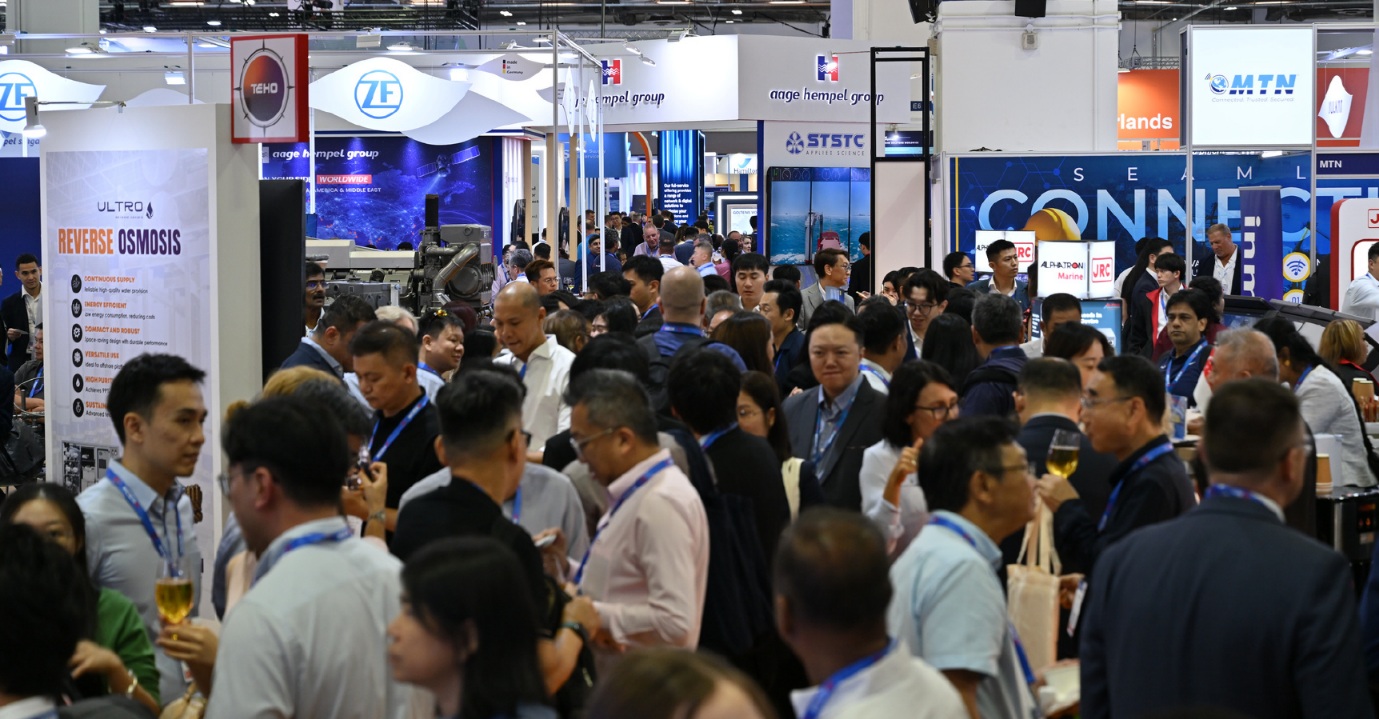
APM 2026 attendees on the exhibition floor
Yeow Hui Leng, Group Project Director of APM, said: “The numerous deals and partnerships announced at the event underscore APM’s role beyond that of a maritime marketplace; it also serves as a platform for showcasing best‑in‑class innovations and setting the stage for solutions that will shape the future of the industry. We thank our partners for their long‑standing support and trust in APM as the premier meeting point for global and regional players—one that fosters meaningful dialogue, bold collaboration, and strategic partnerships that will propel the maritime sector to greater heights.”
This year’s event brought together key decision-makers from across Asia, including shipowners and shipyards. Notably, the Indonesian National Shipowners’ Association (INSA) led a delegation of 60 shipowners representing 20 shipping lines. Carmelita Hartoto, Chairwoman of the Indonesian National Shipowners’ Association (INSA), said, “INSA is delighted to be back at APM. As a long-standing partner of APM, we truly value the opportunity for Indonesian shipowners to engage in productive conversations with global solution providers and industry leaders, forge new partnerships, and connect with industry forerunners. I am confident that the connections and insights gained at APM will shape Indonesia’s growing maritime industry and drive innovation in vessel operations.”
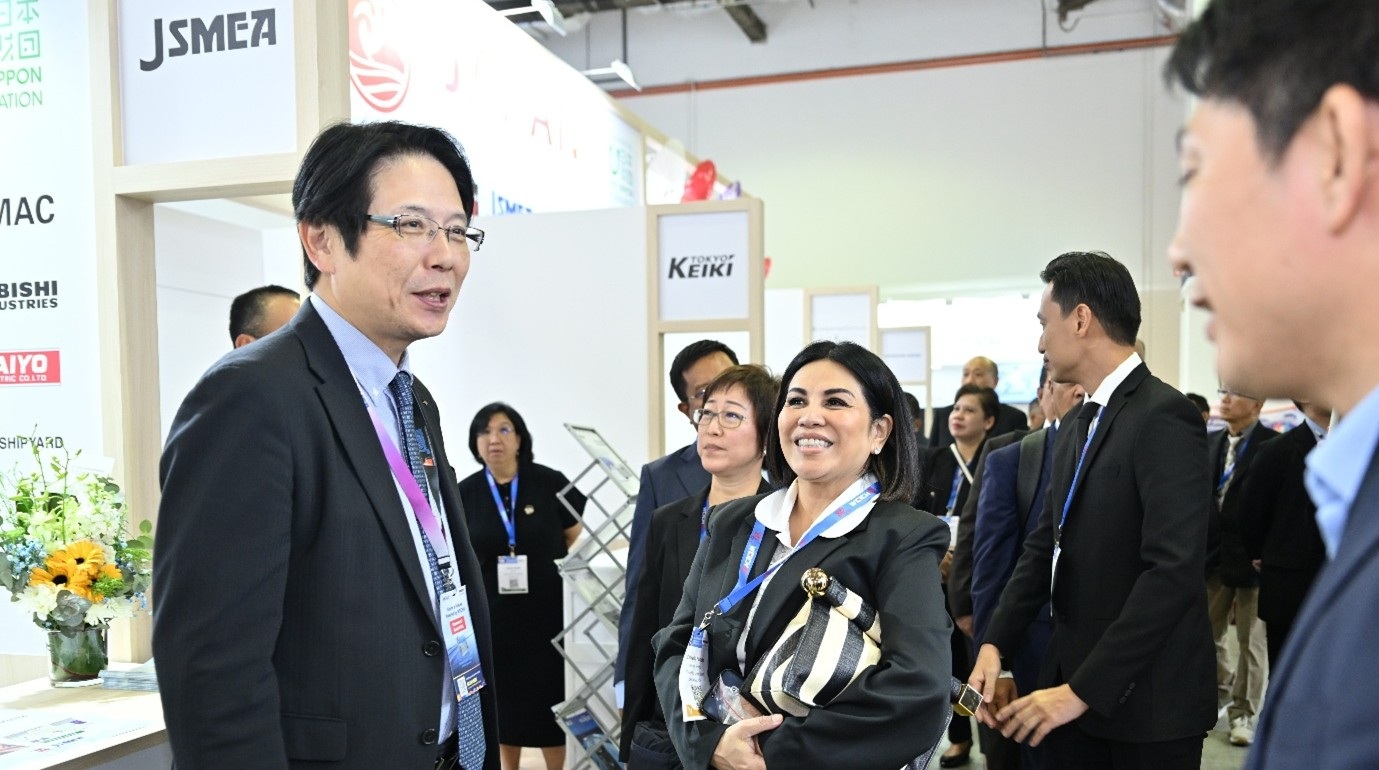
Carmelita Hartoto, Chairwoman of the Indonesian National Shipowners’ Association (INSA), leading the delegation at the Japan Pavilion, organised by the Japan Ship Machinery and Equipment Association (JSMEA).
A myriad of deals, showcases, and partnerships that focused on driving zero emissions with next energy innovations were announced, including:
- Forming of industry partnerships led by VC Power, including collaboration with Bureau Veritas Marine Singaporeon promoting battery technology as a practical and sustainable energy solution; with DNV Singapore for joint development of marine battery training programmes; and with Chengrui Power Technology (Shanghai) and Contemporary Amperex Technology Co., Limited to advance marine battery supply and integration.
- A collaboration partnership to advance next-generation hybrid-electric fleet technology for offshore wind support vessels was signed between Siemens Energy and Marco Polo Shipyard.
- Partnership formalised between Bureau Veritas, Beng Hui Marine Electrical, and Penguin International marked the debut of Bureau Veritas’ Type-Approved PWR+ Power Management and Digital Monitoring System on Penguin International’s new series of compact crewboats for the oil and gas industry.
More activities from the show floor are included in Annex A below in this press release.
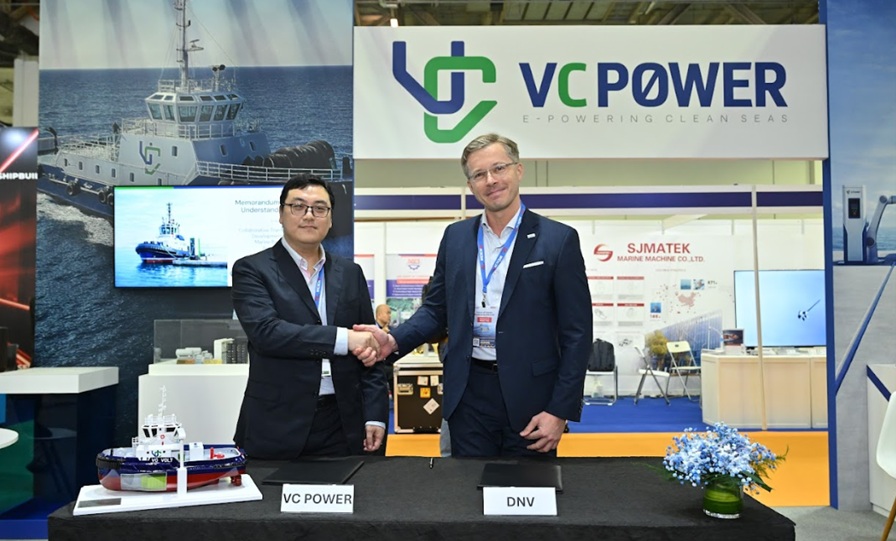
Industry partnerships were signed between VC Power and DNV Singapore.
L to R: Dr Wu Shengweo, Chief Executive Officer (CEO), VC Power and Mr Lukasz Luwanski, Regional Business Development Manager, Det Norske Veritas (DNV).
Next energy in focus, driving net-zero resolutions
Amid the delay in adopting IMO’s net-zero framework and the oil and gas trade disruption caused by current geopolitical conflicts, it has become more crucial to empower decision-makers with a broader range of energy sources and more efficient solutions. The focus on next energy at APM 2026 has become an extremely timely conversation.
The conference posited that conversations on alternative fuels need to continue to progress, despite uncertainty in formal regulatory adoption, especially given the concerns over energy sovereignty.
One message was clear across the various panels – the industry needs to emphasise fuel optionality, because the direction towards net-zero has not changed.
- During the “Ammonia as a Marine Fuel: Unlocking Safety & Scale” panel, panellists debated on how ready ammonia-cable engines and bunkering systems are for commercial deployment.
- Neeraj Kumar, Carbon Solutions Specialist, Mitsui OSK Lines, commented that “the interim guidelines for ammonia is already there, and in future, it’s going to be developed fully and included in the IGF (International Code of Safety for Ships Using Gases or Other Low-flashpoint Fuels) code.” He shared the example of how MOL worked together with Global Centre for Maritime Decarbonisation, Yara Clean Ammonia, and Pilbara Port Authority for the “first twin ammonia STS (ship-to-ship) transfer” – this successful trial showcased how the industry is “matured enough and able to build on the learnings for subsequent bunkering”.
- On the panel, “Securing LNG’s Long-Term Viability as a Shipping Fuel”, speakers delved into the renewed LNG uptake despite the pressure to accelerate decarbonisation, evaluating the fuel’s long-term competitiveness with the popularity of bio-LNG and e-LNG.
- “The use of Bio-LNG or e-LNG is a decarbonisation pathway, and while it is not immediate, it serves as a transition,” said Gobinathan M Ramachanderan, Head, Decarbonization, MISC. He added, “Fossil LNG, which is among the cleanest fossil fuels that is already available and readily scaled, should be expedited, followed closely with the uptake of bio-LNG and e-LNG. These are technology-centric with heavy capex and low uptake. So to have the uptake, it’s always carrot and stick. The countries, the geographical considerations, and the bunkering hubs must be able to cater for the uptake. A fuel is only good when it is available for the entire maritime industry and not only to a section.”
- Separately, the panel on “The Future of Electrification in Shipping: What’s Next?”, highlighted the growing adoption of Lithium Iron Phosphate (LFP) batteries, driven by rapid technological advances and increasing range. It also noted that electrification could pave the way for small modular nuclear reactors (SMRs), though safety and design considerations remain key.
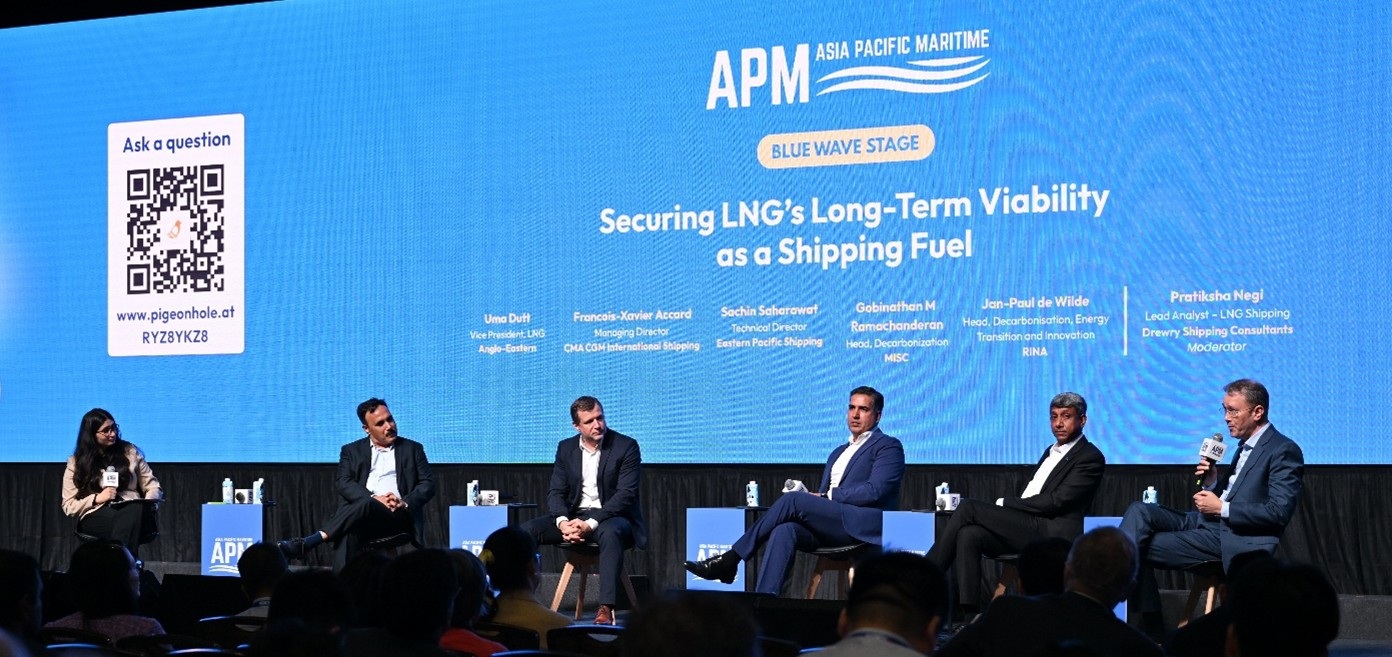
Industry experts at the APM 2026 panel: Securing LNG’s Long-Term Viability as a Shipping Fuel.
APM 2028: Powered by next energy and technological innovations
Next energy and technological innovations have become strategic necessities in today’s maritime industry. The conversations at the conference saw technology providers, shipowners and industry experts convene to explore practical pathways to enable cleaner and more efficient operations. As the industry continues to balance tighter emissions rules, greater fuel uncertainty, and pressure to build resilient supply chains, APM will return for its 20th edition from 22-24 March 2028, diving deeper into next-generation innovations that drive the future of vessels, the solutions for tomorrow.
For more exhibition and conference highlights, please visit the event website, LinkedIn, or Facebook pages.
-END-
About Asia Pacific Maritime (APM)
Asia Pacific Maritime (APM) is Asia’s premier exhibition and conference for Shipbuilding & Marine, Workboat, Offshore, and Electric & Hybrid Marine.
With 35 years of excellence, APM is the pre-eminent platform where global solution providers showcase the latest developments in maritime technology and innovation to shipowners, shipyards, ship managers, and decision-makers across Asia. This is where strategic collaborations are forged, shaping the Future of Vessels, Solutions for Tomorrow.
For more information: https://www.apmaritime.com/
Annex A
Product launches/activities on the show floor included:
- Weichai, alongside partners NTU’s Maritime Energy & Sustainable Development Centre of Excellence (MESD) and the China Classification Society Singapore, held a testing certification ceremony that commemorated the successful completion of a 1,000-hour sea trial of Pinnacle Marine’s (Singapore) President 100. The vessel, operated by Prestige Ocean Pte Ltd, is the first of its kind vessel powered entirely by 100% biodiesel made from renewable feedstock and by B100 engines manufactured by Weichai.
- Volvo Penta introduced its IPS Professional Platform to the Southeast Asia market, marking the next evolution of its integrated propulsion system for larger commercial vessels. Designed with a future-ready dual-power-input concept, the platform also delivers up to a 30% reduction in fuel consumption and emissions.
- Cummins introduced its K50 marine engine to the Asia Pacific market for the first time, a fit-for-market solution designed to meet the real-world operating demands of commercial vessels in the region. With locally optimised specifications tailored to regional operating profiles, the engine offers flexible configurations to meet diverse vessel and mission requirements, providing a solution that is both practical and fit for purpose.
- Nippon Paint Marine unveiled AQUATERRAS 1100; the latest addition to its pioneering AQUATERRAS range, recognised as the world’s first biocide-free hull self-polishing coating system. The new coating features a low-VOC formulation designed to reduce environmental impact while meeting regulatory requirements across major shipbuilding markets, including China and Korea. AQUATERRAS 1100 is also the first in the series to incorporate Advanced Fouling Control (AFC), a proprietary silicone-modified binder technology that creates a smooth, glossy coating surface to prevent fouling without biocides, supporting improved hull performance and long-term vessel efficiency.
- AkzoNobel’s marine coatings brand, International®, launched Intergard®6788, a new aluminium-pigmented universal primer for the Deep Sea segment, designed to simplify and streamline the coating process for newbuild projects. Key benefits include superior performance compared to other products at the same performance level, high-volume solids to enable reduced paint consumption per m² and improve application efficiency, and reduced VOC emissions.
- Joint venture between RMS Marine Service & Hactecke to offer inspection, maintenance, repair, and spare parts services from a single source, providing comprehensive maritime safety equipment services. The joint venture will operate with more than 15 trained technicians and provide 24/7 service availability for vessels calling at Singapore and surrounding ports.
- RUSTIBUS introduced its RUSTIBUS® Eco Series, featuring the RUSTIBUS 2000 ECO and RUSTIBUS 1200 ECO. Built on its established surface preparation platforms, the Eco Series integrates dedicated dust and debris containment systems that capture rust scale, paint particles, and surface contaminants at source. Engineered for marine and offshore environments, the electrically powered machines support cleaner onboard maintenance while reducing the risk of marine pollution, aligning with growing environmental compliance requirements across global fleets.
- Roxtec presented its newly launched Roxtec Cabinet Seal Platform (CSP) for high cable density applications in demanding marine environments. The solution is designed to simplify cable management while maintaining certified sealing performance, supporting increasingly digitalised and electrified vessel architectures.
- Korindo Energy showcased its SCANIA E-Machine, a hybrid and fully electrified configuration designed to support vessel electrification. The compact, modular electric drive system can operate alongside combustion engines or function as a fully electric propulsion unit, enabling flexible transition pathways for shipowners.
- Griffin Filtration launched its latest innovation in advanced fuel filtration – the GFLS50000 Fuel Polisher. The company showcased how the solution sets a new benchmark in reliability, efficiency, and marine fuel management, to transform vessel operations.
- Introduction of HamiltonJet’s EHX solutions to the Asian markets and presentation on HamiltonJet’s integrated approach to delivering hybrid and electric waterjet-propelled vessels. The presentation explored how integrating propulsion, energy systems and controls together under a single model can reduce project risk, simplify procurement and increase confidence among vessel owners, designers, and operators.
- Focus on Integri Marine and Offshore Services’ ‘Making Green Shipping Profitable’ series, including a cold ironing-on-shore power turnkey solution for ships/ports, its proprietary power quality platform that cuts fuel waste and eliminates harmonic distortion (SmartHarmo™), a real-time carbon emissions monitoring system that is EU ETS compliance and minimises vessel downtime, and an intelligent early-warning system that uses AI to detect and predict fire risk onboard before incidents occur, enhancing vessel safety and reducing liability.
Partnerships inked on the show floor included:
- Industry partnerships led by VC Power
- VC Power and Bureau Veritas Marine (Singapore)– Collaboration on promoting battery technology as a practical and sustainable energy solution, developing technical expertise and operational experience in electric tugboats, and establishing a collaborative framework for classification and equipment certification to ensure the safe and effective deployment of E-tug technologies.
- VC Power and DNV Singapore– Joint development of marine battery training programmes, to enhance technical skills, safety awareness, and operational competence for personnel involved in electric vessel operations and shore‑based charging.
- VC Power, Chengrui Power Technology (Shanghai), and Contemporary Amperex Technology Co., Limited– Collaboration to advance marine battery supply and integration, explore innovative battery leasing models, and improve lifecycle management and recycling of marine battery systems.
- Siemens Energy and Marco Polo Shipyard announced a collaboration to advance next-generation hybrid-electric fleet technology for offshore wind support vessels. The collaboration will see Siemens Energy’s integrated BlueDrive PlusC system deployed in a new class of hybrid-electric vessels, combining propulsion, energy storage and intelligent power management to deliver 20–30% reductions in fuel consumption and emissions. Designed as a first-of-its-kind CSOV Plus vessel supporting both offshore wind and oil & gas operations, the initiative underscores how cross-sector collaboration is accelerating the development of scalable, low-emission vessel solutions, while strengthening Asia’s capabilities in supporting the growing offshore renewables market.
- Bureau Veritas, Beng Hui Marine Electrical Pte Ltd, and Penguin International Limited formalised a strategic collaboration at Asia Pacific Maritime (APM) 2026. The signing ceremony, held at the BH Global booth, marked the debut of Bureau Veritas’ Type-Approved PWR+ Power Management and Digital Monitoring System on Penguin International’s new series of compact crewboats for the oil and gas industry. This tripartite collaboration brings together expertise across classification, system integration, and shipbuilding to support the development and deployment of advanced power management and digital monitoring solutions for next-generation vessels. The initiative reflects a shared commitment to enhancing operational efficiency, system visibility, and performance optimisation, while advancing digitalisation and intelligent energy management in the maritime sector.
- The world’s first full-hybrid oil & gas crewboat was unveiled by Penguin International Limited at the Singapore Pavilion, hosted by the Association of Singapore Marine & Offshore Energy Industries (ASMI). Fully privately funded, Pelican Peace was developed in partnership with REINTJES Group, Danfoss Drives, Noris Automation GmbH, Chengrui Power Technology and Razor Blunt Labs.
- Christened Pelican Peace, the 42m multi-role crewboat – a FLEX-42MX HYBRID – is designed, built and operated by Penguin. Unlike shaft-generator or “hybrid-assist” systems, Pelican Peace is built on a true parallel hybrid architecture that auto-switches between operating modes.
- Key features include battery energy storage system (232 kWh of installed capacity) integrated into the main DC grid, hybrid propulsion train enabling engines + motors to drive the shafts, generator-off operations during low-load, standby and overnight modes, peak shaving and load levelling for optimal engine efficiency, lower running hours across main engines and gensets, and reduced fuel burn, emissions and maintenance footprint.
- Scanvik Marine and Brunvoll formalised a strategic partnership to strengthen the delivery of advanced propulsion, manoeuvring, and electrical system solutions across the Asia-Pacific region. It aims to support the industry’s transition towards lower-emissions operations.
- DataFlare and CO2 Connect are developing a maritime carbon emission measurement and accounting solution with go-to-market potential in the Asia Pacific and beyond. The collaboration aims to establish a more standardised and transparent approach to emissions tracking across ports and shipping operations, supporting industry-wide decarbonisation efforts.
- ICF International and ST Engineering signed a Memorandum of Understanding (MoU) to advance specialised vessel interior solutions, including the development of next-generation concepts for platforms such as the Airfish Voyager, reflecting growing innovation across adjacent maritime and mobility segments.
- PT BTI Indo Tekno (BTI Defence) and PT Terafulk Megantara Design officially signed a Design Services Agreement to advance maritime rescue capabilities. The primary objective of this collaboration is to pool the engineering and defense technology expertise of both companies to design a robust, state-of-the-art mothership capable of deploying, operating, and recovering submarine rescue vehicles in critical offshore environments. This partnership addresses the critical need for enhanced underwater safety and emergency response capabilities.